

Day two of Dashboard week and for those navigating the superannuation landscape, understanding a fund’s performance is essential. This guide simplifies how to evaluate these funds using crucial financial metrics, essential for anyone from investors to fund managers.
Key Metrics Explained
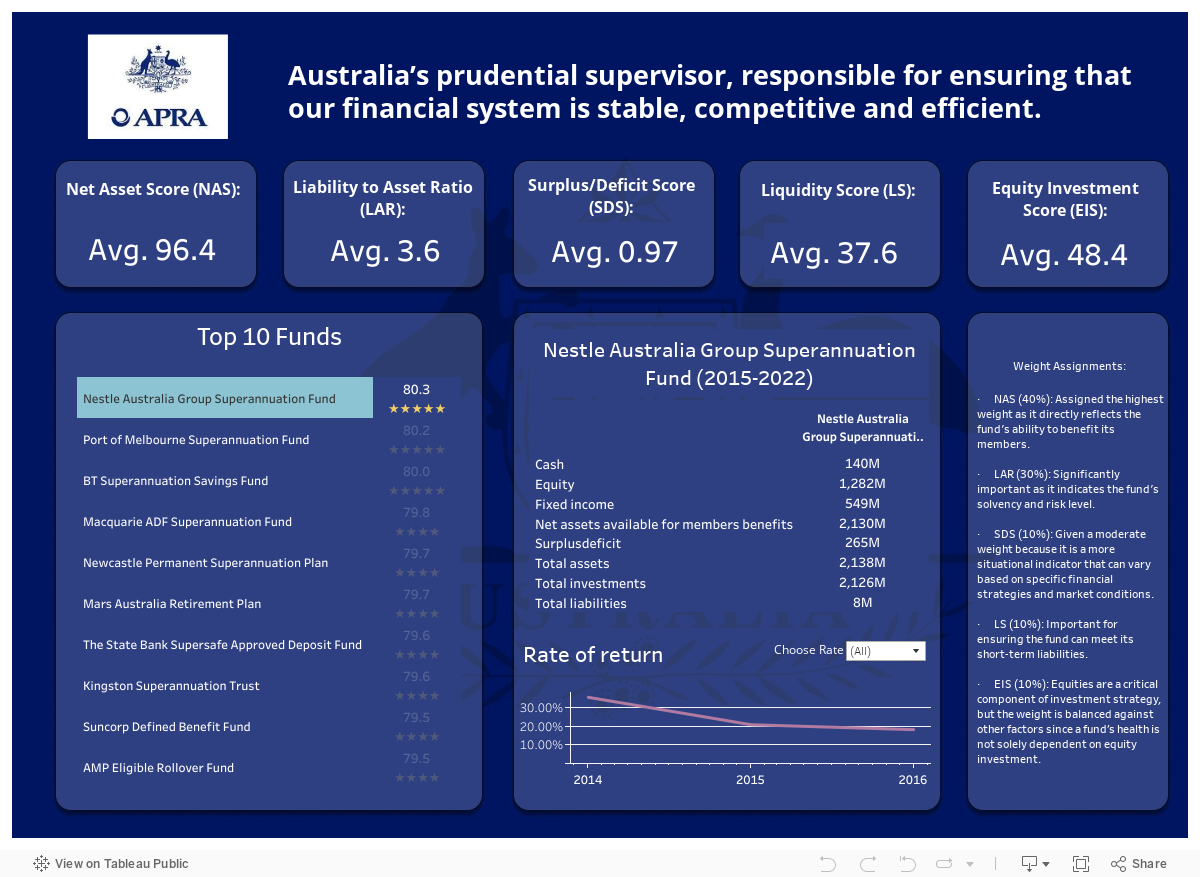
I use five financial metrics to assess superannuation funds: Net Asset Score (NAS), Liability to Asset Ratio (LAR), Surplus/Deficit Score (SDS), Liquidity Score (LS), and Equity Investment Score (EIS).
- Net Asset Score (NAS):
- Formula: NAS = (Net assets available for members’ benefits / Total assets) × 100
- Significance: It shows the percentage of assets available for members, indicating the fund’s financial health and efficiency.
- Liability to Asset Ratio (LAR):
- Formula: LAR = (Total liabilities / Total assets) × 100 (Inverted in scoring: 100 – LAR)
- Significance: A lower LAR means a stronger financial position, suggesting lower financial risk.
- Surplus/Deficit Score (SDS):
- Formula: SDS = (Surplus/deficit in net assets / Total assets) × 100
- Significance: Reflects the fund’s profitability and financial adjustments over time.
- Liquidity Score (LS):
- Formula: LS = (Cash + Fixed income / Total investments) × 100
- Significance: A higher LS indicates better short-term financial stability, crucial for meeting immediate obligations.
- Equity Investment Score (EIS):
- Formula: EIS = (Equity / Total investments) × 100
- Significance: Shows the fund’s investment in equities, reflecting its investment strategy and risk profile.
Weighting Each Metric
- NAS (40%): Gets the highest weight, reflecting its direct impact on member benefits.
- LAR (30%): Important for showing the fund’s solvency and risk level.
- SDS (10%), LS (10%), EIS (10%): These are given moderate weights, balancing their importance with the fund’s overall health and strategy.
Conclusion
This approach to ranking superannuation funds using these formulas and weight assignments offers a clear, quantifiable method to assess a fund’s performance. It allows for a balanced view, incorporating both immediate financial health and long-term investment strategies.
